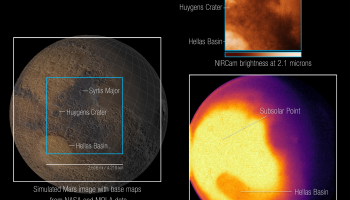
The Principal Investigator (PI) for the NOMAD instrument onboard ESA’s ExoMars Trace Gas Orbiter - currently orbiting and observing the planet Mars – is the group Planetary Atmospheres of BIRA-IASB. Consequently, it is up to our researchers and engineers of this group to handle, among other things, the calibration (to check how accurately the instrument is working) and the set-up and maintenance of the data pipeline (the software that converts all the incoming raw data into information that the scientists can analyse).

Researchers of the Royal Belgian Institute for Space Aeronomy have no need for energy drinks in order to get airborne, they simply work together with Dr Thomas Ruhtz’s team at Freie Universität Berlin (FUB) who have an airplane at their disposal. Together with the Université Libre de Bruxelles (ULB), each of the three institutes contribute their equipment and expertise to the ESA-funded NITROCAM campaign for the measurement of air pollution due to nitrogen compounds.

No more PASTA for Italian astronaut Samantha Cristoforetti, who will be the eighth astronaut to manipulate the Soft Matter Dynamics Container (SMD) and replace the PASTA experiment cells with those from FOAM-C.

On July 19 & 20, space lovers can fill their hearts and heads with planets, meteors, space weather and astronautics at this year's edition of Astropolis Space Village, in Ostend, Flanders. Free entrance !

A few years ago the European Space Agency’s Rosetta spacecraft visited comet 67P Churyumov-Gerasimenko (2014-2016). You may remember the spectacular images of the Philae lander as it settled down on the comet surface. The scientific instruments onboard Rosetta collected detailed measurements of the comet. In particular, the Double Focusing Mass Spectrometer (Rosina-DFMS) – built by the University of Bern with important contributions from the Royal Belgian Institute for Space Aeronomy (BIRA-IASB) in Uccle – has turned out to provide fascinating information about the comet’s composition.

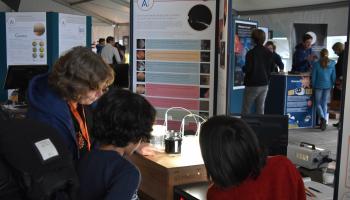
This year's autumn will be kicked off by a new edition of the Space Pole's Open Doors! On Saturday and Sunday, September 24 and 25, you will get the unique opportunity to step onto the grounds of the Space Pole in Uccle (free entrance). A weekend of fun and games for the youngest, scientific discovery for the whole family and direct interaction with the scientists themselves. Whether you come to see the telescopes or to learn about the weather, the climate, the aurora or the planets of the solar system, we have it all lined up for you. See you then!